

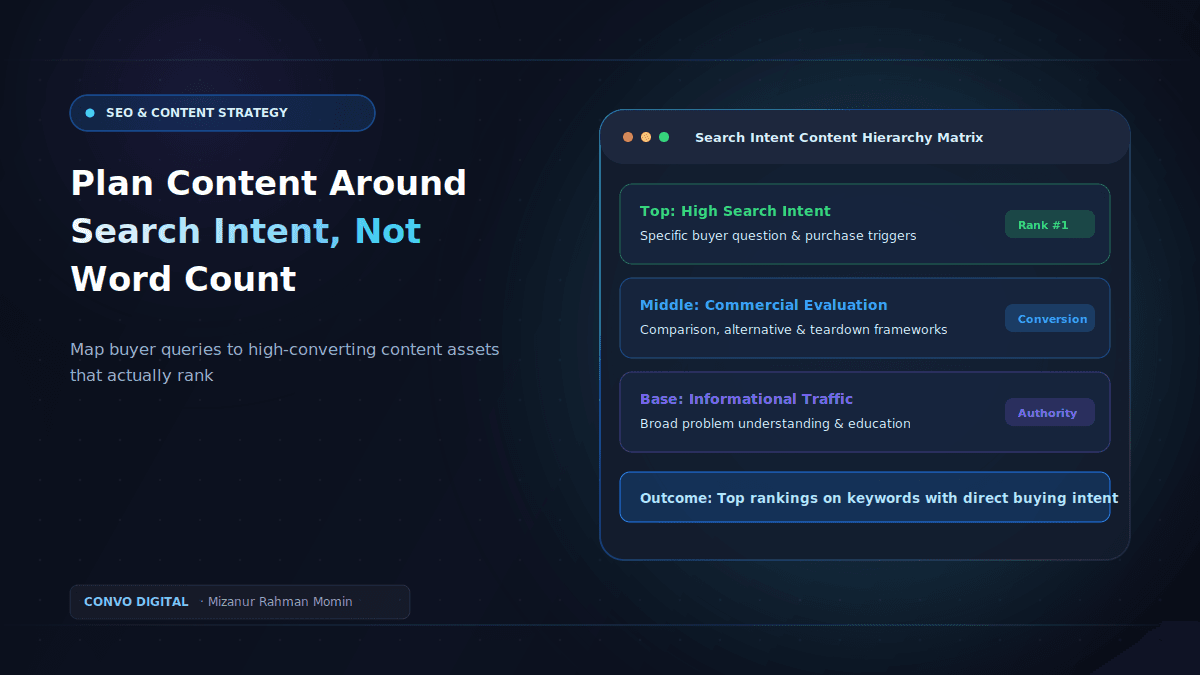
Word count does not rank a page. Search intent does.
Before you write anything, decide what the reader wants to do. Then write the shortest piece that helps them do it. That one habit improves more content than any keyword tool.
What search intent means
Search intent is the reason behind a search. Two people can type similar words and want very different things.
- One wants a quick answer.
- One wants to compare options.
- One wants to buy.
- One wants to learn a skill.
If your page gives the wrong thing, it will not satisfy the search. No amount of length fixes that.
The four common intents
| Intent | What the reader wants | A useful format |
|---|---|---|
| Informational | To understand something | A short guide or explainer |
| Commercial | To compare options | A comparison or review |
| Transactional | To take an action | A clear page with one next step |
| Navigational | To reach a known place | A simple, direct page |
Decide the intent first. The format follows from it.
Match the format to the intent
A reader looking for a definition does not want a 3,000-word essay. A reader comparing tools does not want a single paragraph.
A useful pattern for most pages:
- Answer the question near the top.
- Explain the reasoning below.
- Add examples or a table.
- End with one clear next step.
Plan before you write
A content calendar is not a list of keywords. It is a list of questions.
For each planned piece, write down:
- Who is searching.
- What they want to do.
- What a good answer looks like.
- What the next step is.
That is enough to start. You do not need a long brief.
What to measure
Judge content by whether it helped, not by how long it is.
- Did people stay and read?
- Did they click the next step?
- Did the page answer the question in its title?
These signals matter more than word count.
Common mistakes
- Writing for length. Padding a page makes it worse, not better.
- Ignoring the question. A clever angle that misses the intent will not rank.
- Too many next steps. One clear action beats five weak ones.
- Copying competitors. Their page may rank for a different intent.